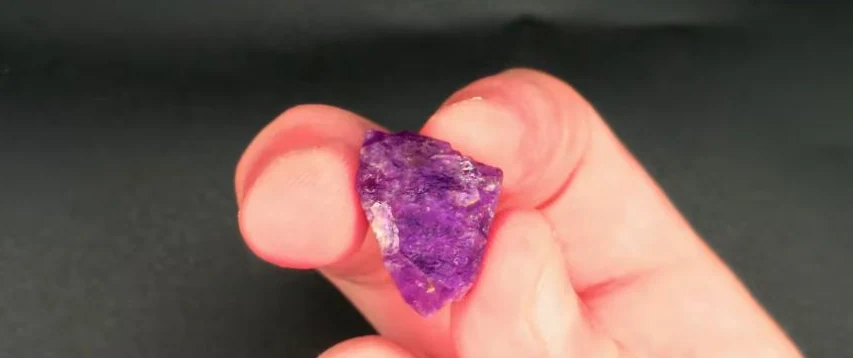
The video starts with an ordinary-looking stone and introduces a much brighter appearance under ultraviolet light. That contrast is a starting point for observation. The useful next questions are where the response occurs, what lighting was used and what remains unknown about the material.
Original video · 1:56 This Crystal Looks Ordinary—Until the UV Light Turns On | Volcano Agate
The UV explanation is plausible for some minerals, but it does not identify the material or activator in this specimen.
Qualification · The trade label
Keep Volcano Agate as the supplied commercial label. The narration’s account of agate formation is general background, not evidence that this particular piece has that composition or geological history.
Supported mechanism · Unconfirmed specimen
Published mineral research documents uranyl-related fluorescence in some agate, chalcedony and opal. A green glow alone does not demonstrate that cause, uranium content or safety in this piece. The video already identifies its spiritual associations as beliefs.
Reviewed using available English captions and the references below. This updates the website notes; the original YouTube narration remains unchanged.
The narration describes variation in the strength and extent of the response rather than promising the same glow from every piece.
Separate collection photograph · Volcano Agate Under ultraviolet light, a broad green patch and a fainter green curve stand out among thin pale lines. Photograph by Rock & Crystal Secrets. See the numbered photo observations →
01 · Look a little closer
Observe the patches, not just the spectacle.
On the first viewing, note the contrast between the normal-light presentation and the UV presentation. On the second, look for boundaries: is the response spread widely, concentrated in small patches or mixed with darker areas? Use ordinary descriptive words before assigning a mineral identity.
Keep “bright under the conditions shown” separate from “always bright”. Lamp wavelength, surrounding light and camera settings belong with a useful observation. If a detail is not supplied, write “not stated” instead of guessing a number from the colour of the image.
02 · Look a little closer
Fluorescence is a response to illumination.
In this context, fluorescence is visible light emitted while a material is exposed to UV. A continuing glow after the exciting light is removed is called phosphorescence. A bright UV photograph by itself does not demonstrate that afterglow.
Mineral fluorescence can depend on chemical constituents, trace activators or defects in the structure. The video mentions uranyl ions as a possible explanation for some fluorescent agates. That is not an analysis of this specimen: the exact emitting material and cause would need evidence beyond the displayed colour.
03 · Look a little closer
Treat Volcano Agate as a label to investigate.
Our encyclopedia records Volcano Agate as a trade name without one fixed composition. The video also introduces it as a commercial name. Keep that wording on the label; do not silently turn it into a confirmed mineral species or assume that every similarly named product is identical.
The video’s later references to grounding and transformation belong to crystal traditions. They do not establish scientific effects. For this exercise, watching the published footage is enough: you do not need to obtain a UV lamp or perform a home test to practise careful observation.
Pause. Replay. Describe.
Try this while watching
Make two headings: Normal light and UV presentation. Record a visible colour or pattern beneath each.
Describe where the brighter response appears, without deciding what every patch is made from.
List the missing details you would ask about: lamp wavelength, specimen identification and any known treatment.
Sources and further reading
Written for Rock & Crystal Secrets. Video narration and mineral references checked 5 October 2026. This is an original reading companion, not a transcript or a laboratory identification.