Labradorite can show a strong, directional flash of colour called labradorescence. Classic moonstone has a shifting sheen called adularescence, often blue or white. The effects can look alike. Compare how much of the face lights up, where the colour appears relative to a fixed mark, and how it changes as you turn the stone.
Labradorite
Rock & Crystal Secrets collection photo labelled Labradorite. A broad blue-grey area and a narrow white highlight appear in this view. The Light Lab frames below come from a video recorded separately.
Moonstone
Rock & Crystal Secrets collection photo labelled Moonstone. This is a separate photograph from the Short below. The supplied name is recorded, and the exact feldspar identity remains unverified.
Follow the light across two views
These stills come from two separate Rock & Crystal Secrets videos. The angle changes within each pair. Lighting and framing differ between the two videos.
Labradorite video example
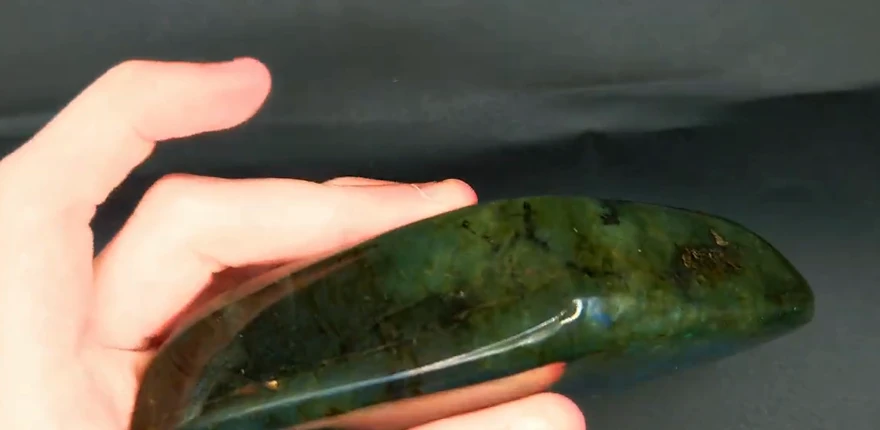
Quieter angle · 0:16
This angle shows a green-grey edge with a thin line of reflected light.
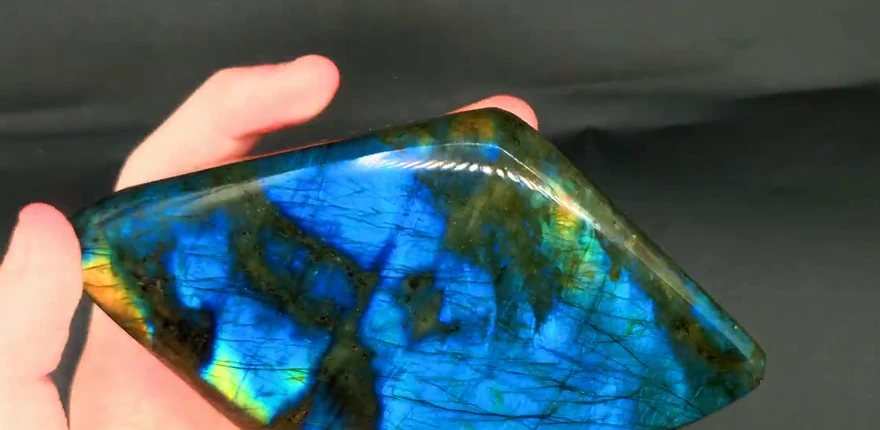
Blue flash · 0:18
Bright blue covers much of the broad face. Several dark lines remain visible across it.
Reference properties describe the materials generally. They do not authenticate the photographed specimens.
Labradorite vs moonstone: reference properties
Clue
Labradorite
Moonstone
Material behind the name
A plagioclase feldspar. Some pieces show labradorescence.
Classic moonstone is an alkali feldspar. “Rainbow moonstone” is a trade name commonly used for transparent labradorite.
Quieter view in our footage
At 0:16, the green-grey edge dominates and a thin white reflection follows the polished curve.
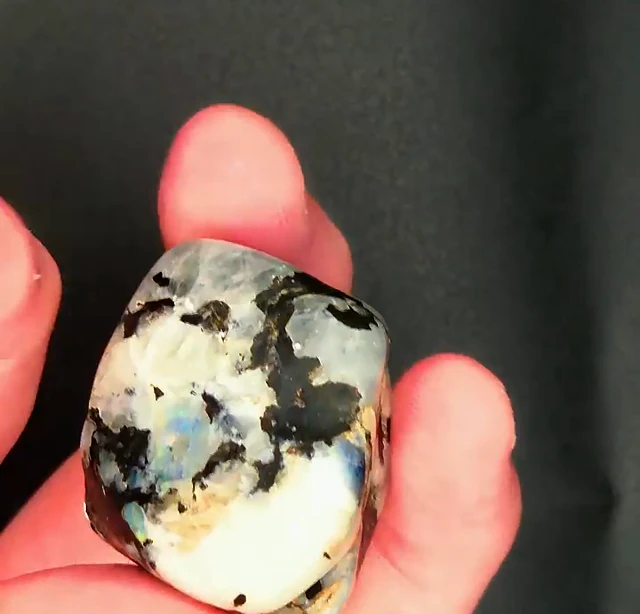
At 0:01.7, the pale body and irregular dark markings stand out, with a muted blue area between them.
Brighter view in our footage
At 0:18, vivid blue spans much of the broad face. Several dark lines remain visible.
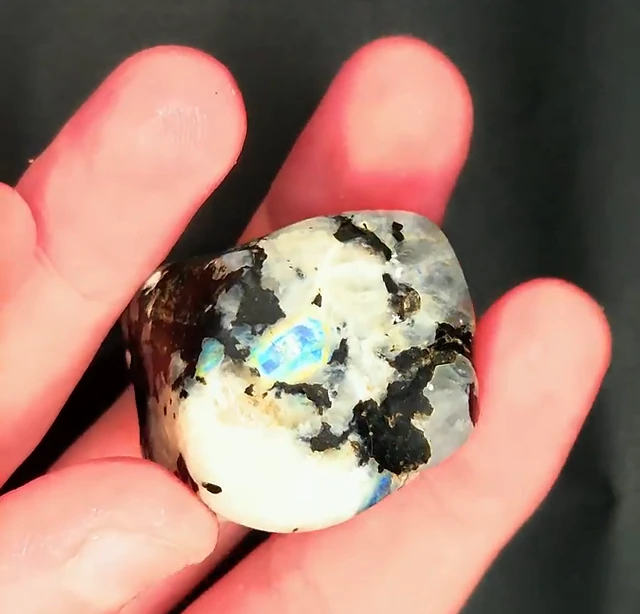
At 0:02.7, a smaller patch between dark markings is vivid blue with a yellowish edge.
A fixed mark to track
Pick a dark line running through the blue area and follow it as the face turns.
Follow a dark mark next to the blue patch as the pale stone turns.
01 · Read the clues
Track three clues on the same face.
Start with the body colour in a quieter view. In the Labradorite clip, green-grey is easiest to see when the piece is nearly edge-on. In the Moonstone Short, pale areas and irregular dark marks stand out before the brighter patch catches your eye.
Next, follow a coloured patch against a fixed mark. Watch whether the patch spreads, fades or brightens as the face turns. Finally, watch for the light source reflected at the surface. The Labradorite clip shows this especially clearly in the narrow white highlight along the polished edge. Keep those three observations in separate lines in your notes.
The clips show different stones under different filming conditions. Their colours and patch sizes describe these views. Both labradorite flash and moonstone sheen involve light interacting with microscopic feldspar layers, and the effects can overlap in appearance.
02 · Read the clues
Change one thing at a time.
Use one ordinary lamp and a stable surface. Choose a visible line or dot on the stone, then keep the lamp and your own viewing position steady. Gently tilt the stone from left to centre to right, then return to the starting angle. Write down the body colour, where the coloured patch was brightest, and where a sharp reflection crossed the face. Check what returns as you go back.
Place the stone back at its starting angle. Shift the lamp slightly to one side and leave it there for a second pass. Compare how the coloured area and sharp highlight change with the light position. Both can move with angle. The point of the second pass is to describe each feature more precisely, especially when glare covers the area you are watching.
03 · Read the clues
Keep the label with the evidence.
A worked note might read “Labelled Moonstone. Pale body with a dark mark. A blue patch brightens beside the mark on the return tilt. A sharp highlight crosses the edge. Feldspar identity uncertain.” That still gives you an observation you can repeat or show someone else.
If the exact material matters for a purchase or a collection record, ask which feldspar was identified and what evidence supports that identification. GIA describes a rainbow moonstone example whose labradorite identity was confirmed by Raman spectroscopy. Keep any report or seller statement with the original label and your notes.
Try it without damaging a stone
A one-minute observation
Use the quiet and bright frames above. For each clip, write one body colour, one fixed mark and one change in the coloured patch or reflection. Circle the clue you could check again by returning to the first angle. Leave the result open if the view hides the feature.
Does a blue flash identify moonstone or labradorite?
Both can show blue. The same-looking colour can appear in several feldspars, and trade names can overlap. Record the effect and supplied label separately. A visual comparison helps you choose what to examine next.
Why does the colour disappear when I turn the stone?
The brightness depends on the angle between the light, stone and viewer. A slight turn can send less of that coloured light towards you. Return to the starting angle and see if it appears again.
How can I check whether glare is covering the sheen?
Pick a small mark near the bright area and compare it across several gentle tilts. A sharp highlight can trace an edge or resemble the light source. Try a second lamp position to see what becomes visible when that highlight shifts.
Sources and further reading
Checked 25 November 2026. General mineral information supports these comparisons; collection labels are not laboratory identifications.