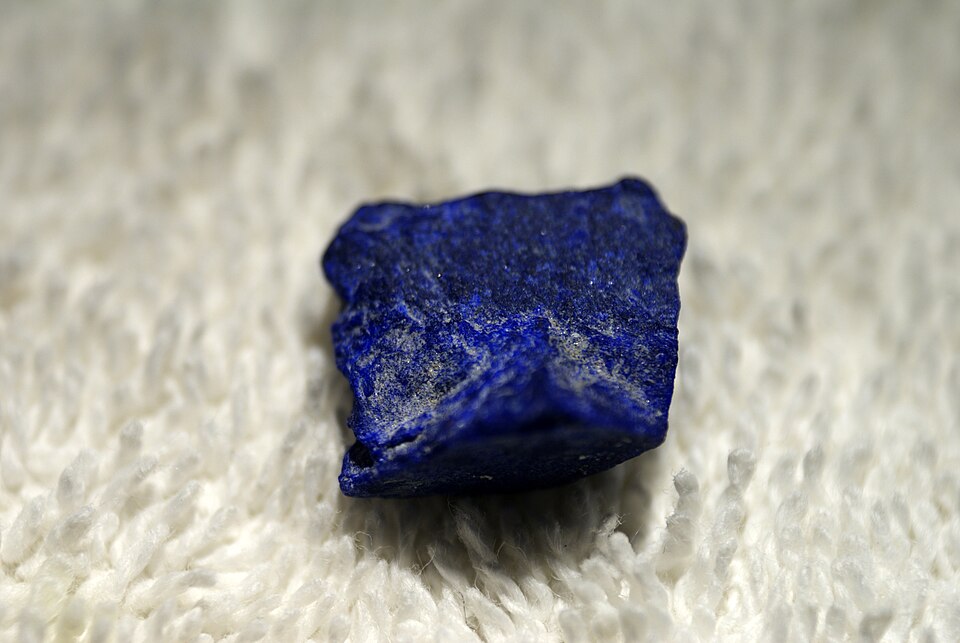
Notice the uneven blue colour and pale patches. This rough piece illustrates why it helps to describe separate areas of a stone.
LapisLazuli.JPG · Teravolt at English Wikipedia / CC BY 3.0 (via Wikimedia Commons). Reduced-size preview; no further image changes.Identification clues
Look for a blue body, sometimes interrupted by white patches or small metallic gold-coloured flecks. Lazurite supplies the characteristic blue; calcite and pyrite are common companions. Not every piece shows all three clearly.
Mineral facts and formation
Lapis lazuli is a rock made from several minerals. In a documented Chilean deposit, heat altered the limestone and sulphur was later introduced, helping blue lazurite form. The proportions of minerals vary, and the locality of the specimen in the reference photo remains unknown.
Lookalikes and useful comparisons
A blue stone is not automatically lapis. Record the distribution of blue, white and metallic areas before comparing a reference specimen. A dyed material can imitate colour; a photograph cannot establish treatment history.
Compare Lapis Lazuli side by side →Care for a display specimen
Start with a soft dry cloth on a sound display surface. Check for dye, wax or repairs before washing. If warm soapy water is suitable for the piece, clean it gently and dry it carefully. Avoid steam, ultrasonic cleaning and strong chemicals.
Look a little closer
Try this observation.
Make a three-column note: body colour, pale patches, metallic flecks. Record “not visible” when a feature is absent instead of assuming every lapis must show it.
Are the gold-coloured flecks gold?
Pyrite commonly produces the gold-coloured flecks seen in lapis. Flecks are a clue to record, but they cannot identify an unknown blue stone on their own.
Sources and review
Use these references to check the mineral’s properties, compare specimens and follow the care guidance.
- GIA: Lapis lazuli (opens in a new tab)
- Lapis Lazuli from the Coquimbo Region, Chile (Gems & Gemology) (opens in a new tab)
- GIA: Lapis care and cleaning (opens in a new tab)
Reviewed by Rock & Crystal Secrets on 24 November 2026. How we review guides · Suggest a correction